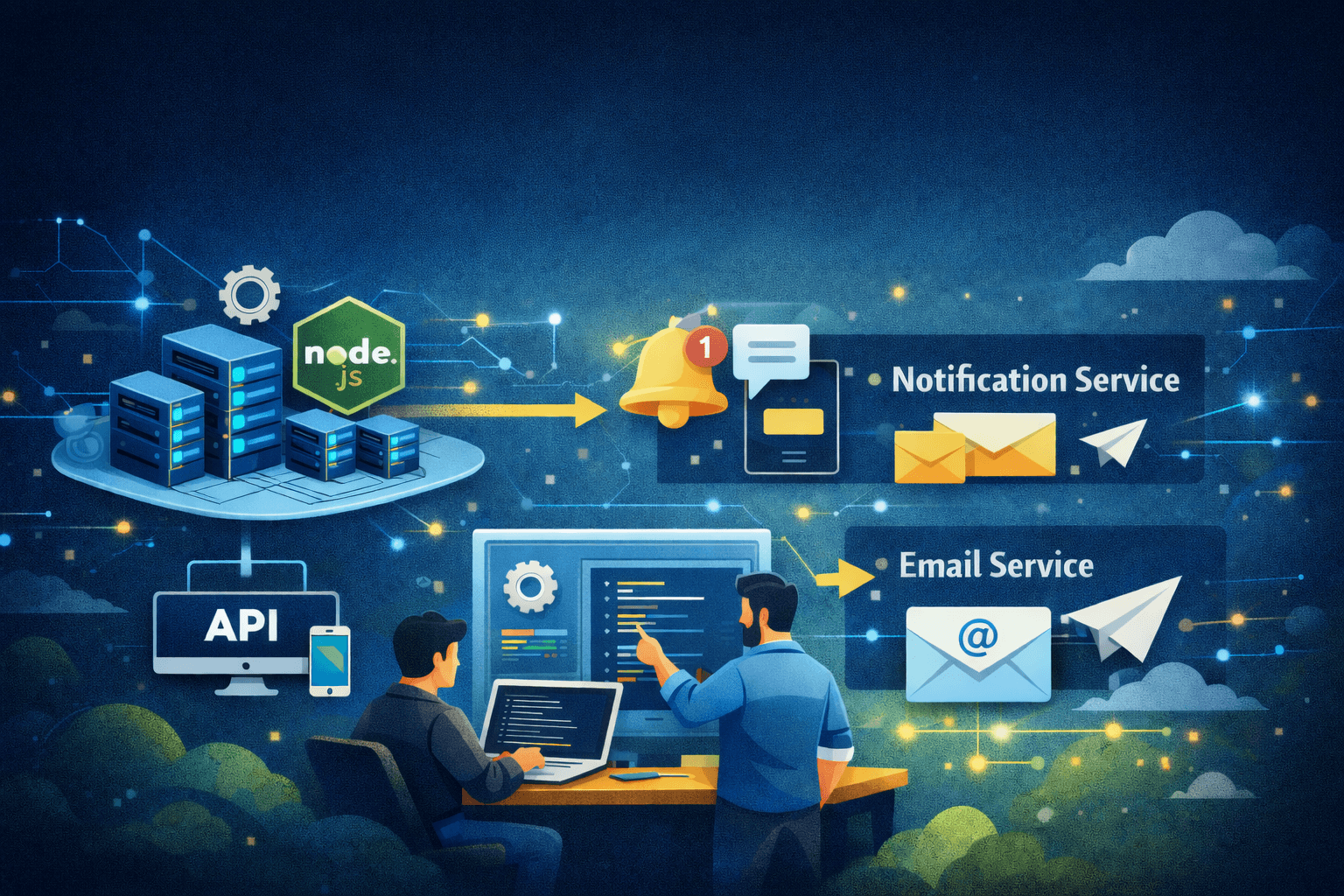
Modern backend development is no longer just about creating endpoints and connecting a database. Real-world applications demand much more. They need APIs that are clean and consistent, notification systems that react to business events reliably, and email services that deliver transactional communication without becoming a maintenance headache.
In this article, I’ll walk through how to design scalable backend services in Node.js from a senior developer’s perspective, with a focus on API architecture, notification handling, and email service design.
Why Node.js Still Works So Well for Backend Services
Node.js remains one of the most practical technologies for backend systems, especially for applications that are I/O-heavy. Most backend services spend more time waiting on databases, third-party APIs, queues, or email providers than they do performing CPU-heavy calculations. That makes Node.js a strong fit because of its event-driven, non-blocking architecture.
API Design Should Be More Than Just Routes
A lot of backend projects begin with simple route handlers and direct database calls. That approach may work for a small prototype, but it breaks down quickly in production systems.
- The route layer maps the endpoint.
- The controller handles the request and response cycle.
- The service layer manages business logic.
- The repository or model layer handles database interaction.
This separation matters because APIs evolve. Requirements change, validations grow, business rules get added, and integrations become more complex. When logic is packed into a controller, even small changes become risky. When logic is organized properly, the code stays maintainable.
What a Clean API Flow Looks Like
A clean API should follow a predictable flow. A request enters through the route. Validation middleware checks the payload. Authentication middleware verifies the user. The controller then passes only the necessary data to the service layer. The service performs business rules, updates the database, triggers related workflows, and returns a structured result. Finally, the controller sends a consistent response back to the client. This kind of flow keeps the code readable and makes testing easier. It also allows teams to change one part of the system without affecting everything else.
The Service Layer Is Where Backend Design Gets Serious
The service layer is the core of the application. This is where the real business logic belongs. For example, if you are handling an arrival check-in workflow, the service layer may need to validate the address, compare old and new values, calculate distance, store the updated record, create audit history, and trigger notifications or emails based on who submitted the change.
That logic should not live in the controller.
A controller should stay thin. Its job is orchestration, not decision-making. Once controllers start containing validation rules, database queries, notification logic, and conditional branching, the code becomes harder to reuse and harder to debug. The service layer is where backend systems become scalable because it creates a clean place for business workflows to live.
Notification Services Need More Design Than Most Teams Expect
Notifications often start as a small feature and turn into a critical part of the application. At first, it may seem simple to save a message in the database or send an alert after a user action. But over time, notification logic becomes much more complex. Different roles may need different messages. Some events require in-app notifications, some require email, and some require both. There may also be conditions around impersonation, first-time actions, approval states, or audit history.
This is why notification handling should be treated as a dedicated service, not as a few helper functions spread across modules.
A strong notification service should define who receives the message, what event triggered it, which channel should be used, whether the message needs to be stored for history, and what retry behavior should happen if delivery fails.
Once notification logic is centralized, the system becomes much easier to maintain. It also becomes easier to update message formats, add new delivery channels, or troubleshoot missed alerts.
Example: Business Event–Driven Notifications
Consider a workflow where a sponsor impersonates a teacher and submits arrival details for the first time. That single action may involve multiple backend responsibilities.
The system may need to save the arrival record, log the impersonated action in audit history, notify the sponsor, inform admins, and possibly send an email confirmation. If every module handles its own piece independently, this flow becomes inconsistent very quickly.
A dedicated notification service solves that problem by making event handling structured and repeatable. Instead of hardcoding notification behavior in multiple places, the backend reacts to a business event in a standard way.
That design is far more reliable in the long run.
Email Services Should Be Built as a System, Not a Utility Function
Many projects treat email as a simple sendMail call. That works at first, but it does not scale well.
Email is usually part of critical workflows such as account onboarding, password reset, booking confirmation, status updates, approvals, and alerts. These emails often need dynamic templates, provider integrations, retries, error handling, and delivery monitoring. A proper email service should include template management, provider abstraction, logging, and structured methods for specific email scenarios.
For example, instead of calling a generic sendMail function throughout the codebase, it is much cleaner to expose use-case-based methods such as sendWelcomeEmail, sendPasswordResetEmail, or sendArrivalUpdateEmail. This makes the system more readable because the business intent is clear. It also reduces coupling because the rest of the application does not need to know whether the actual provider is SMTP, SendGrid, Amazon SES, or something else.
Why Provider Abstraction Matters
One of the most common backend mistakes is tying the application too closely to a single third-party email provider. That creates pain later when credentials change, provider limits are hit, or teams decide to migrate to another platform.
A provider abstraction layer avoids that problem. The application should interact with an email service interface, while the provider-specific implementation stays underneath it.
This approach makes the code more flexible and easier to test. It also helps isolate failures related to external services.
Synchronous vs Asynchronous Processing
- One major architectural decision in backend systems is deciding which operations should happen during the API request and which should happen in the background.
- For business-critical database updates, synchronous execution makes sense because the API should confirm the action was completed. But for emails and many notifications, asynchronous processing is usually the better choice.
- External providers can be slow. Network calls can fail. Retries may be needed. None of that should block the user-facing request longer than necessary.
- A more resilient design is to save the core business data first, publish an event or queue a job, and let a background worker process notifications and emails separately.
- This makes the system faster for users and safer in production. It also allows failed delivery attempts to be retried without affecting the main application flow.
Observability Is the Missing Layer in Many Node.js Projects
Even well-written code can fail in production. That is why observability matters.
Tracking these signals helps teams catch issues early and improve reliability over time. Observability turns backend development from reactive debugging into proactive maintenance.
Final Thoughts
Node.js is an excellent choice for backend applications, but building production-ready services requires more than exposing routes and calling external providers. A solid backend needs structure. It needs clear API boundaries, service-based business logic, centralized notification handling, and an email system designed for reliability.
When API design, notification workflows, and email services are built with that mindset, Node.js becomes a powerful foundation for scalable backend development.