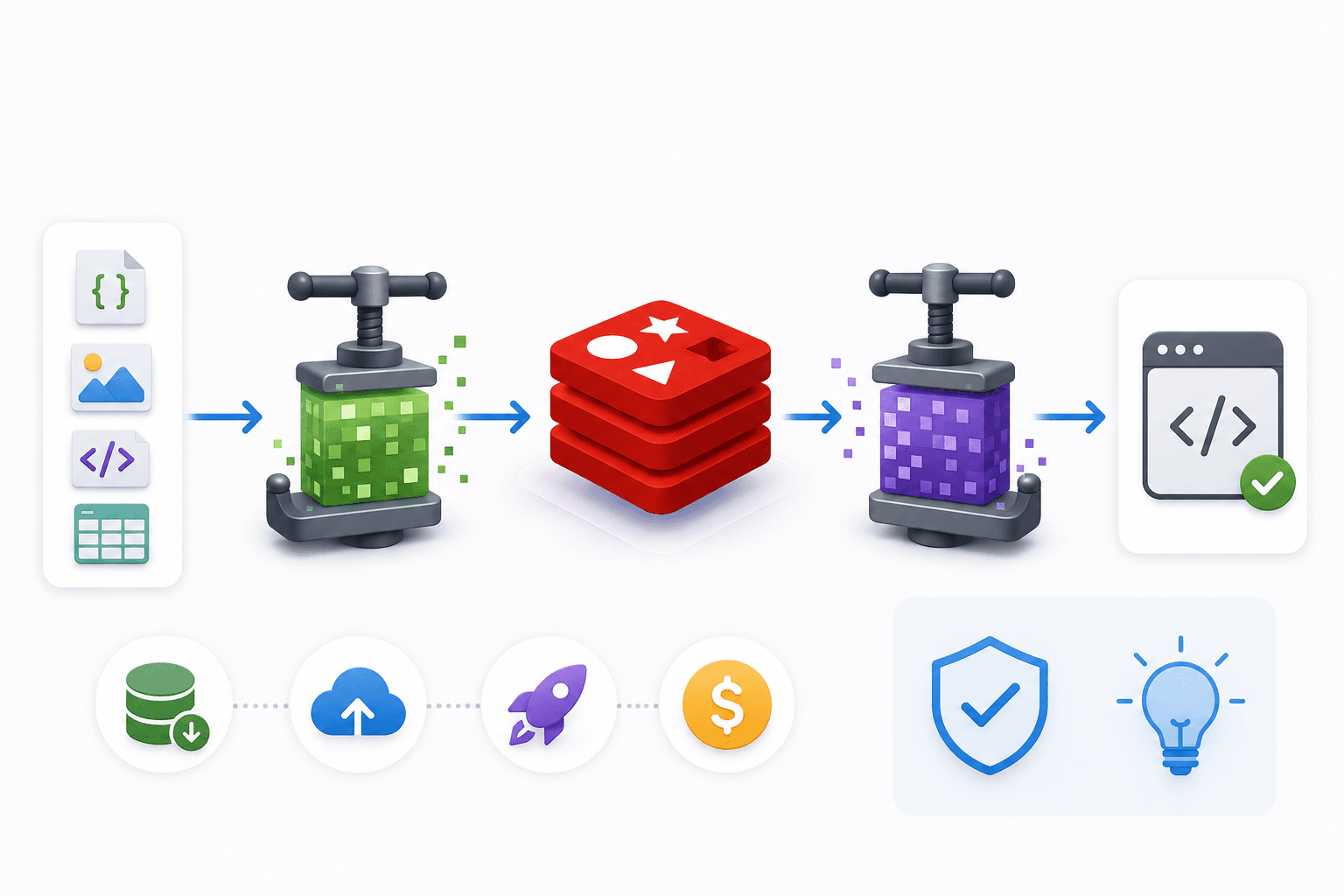
One small engineering habit that made a measurable difference — and why it matters more as a business decision than a technical one.
What Is Redis and Why Do Teams Use It?
Redis is an in-memory data store — your application’s short-term memory. It holds information your system needs to retrieve quickly, without going back to the database every time. Things like user sessions, search results, configuration settings, API credentials, and pricing data — anything expensive to recalculate and likely to be needed again soon.
It’s fast. Extremely fast. But fast comes with a trade-off: memory is expensive. Unlike a traditional database that lives on a hard drive, Redis holds everything in RAM — and RAM on managed cloud platforms like AWS ElastiCache, Upstash, or Redis Cloud costs real money per gigabyte.
The Problem Nobody Notices Until It’s Too Late
In early development, the data you cache is small — a few config values, a token here and there. Memory usage looks fine. Nobody worries. Then your product matures. Cached data gets richer: more fields, nested structures, more detail. Third-party supplier responses, user preference sets, content payloads. These aren’t a few hundred bytes anymore — they’re tens or hundreds of kilobytes per cached entry.
Multiply that by concurrent users, active sessions, and cache keys in play — and suddenly your Redis memory footprint is 3x what you planned. You upgrade your Redis plan. Bills go up. Traffic grows. You upgrade again. It becomes a cycle.
“The data was always larger than it needed to be. You were just paying to store the waste.”
What Compression Actually Does
Think of packing a suitcase. You could throw clothes in loosely — that’s how most systems store data by default. Or you could vacuum-seal everything: 10 seconds of effort, twice as much in the same bag. Compression is the vacuum seal.
Before data goes into Redis, repetitive patterns, predictable structures, and redundant formatting get collapsed down to a fraction of the original size. When the data comes back out, it gets restored to its original shape instantly. The result: the same information, stored in 20–40% of the original space.
Why This Is a Business Decision, Not Just a Technical One
| Lower Infrastructure Costs |
Redis pricing scales with memory. Less memory used means a lower tier, which means a smaller monthly bill. For teams storing large, structured data in cache, that gap between tiers can be significant. This isn’t a future optimisation — it’s money leaving your account every month until you address it. |
| Delays Expensive Upgrades |
Every time you hit a memory ceiling, you face a choice: optimise or upgrade. Upgrading is faster in the moment but costs more forever. Compression is a one-time decision that pushes that ceiling further away — sometimes by months — without any change to your infrastructure. |
| Ripple Effect on AWS S3 |
The same bloated data shapes that hurt Redis tend to show up in S3 too. Costs hide in data transfer out to CloudFront, request volume at scale, and long-term archive growth. Teams that compress at the cache layer often find themselves writing leaner data shapes everywhere. |
| Better Performance |
Smaller data moving between your application and Redis means faster responses. Faster APIs mean better conversion — and better conversion means revenue. Cost savings and performance gains from the same decision is a rare combination. |
When Compression Makes Sense — And When It Doesn’t
| ✓ Strong business case |
— Less impactful |
- Caching large structured API or database responses
- On cloud-managed Redis where memory is directly billed
- High cache-hit rates — read far more than you write
- Content-rich data: search results, config sets, user profiles
|
- Caching tiny values — short strings, single numbers, flags
- Redis usage well within your current plan’s limits
- Operating at a scale where savings aren’t yet material
|
The Mindset Shift That Matters
The deeper lesson isn’t about compression specifically. It’s about treating data size as a cost — not just a technical detail. Every kilobyte you store in Redis is money. Every megabyte you transfer through CloudFront is money. Every API response you log uncompressed to S3 is money, accumulating quietly in the background.
Small decisions about how data is shaped and stored compound into significant infrastructure costs at scale. The teams that stay lean are the ones who treat these decisions seriously early — not after the bills arrive.
ViteTech
We work with teams to build backend systems that are efficient from day one — not just functional. If you’re thinking about your caching strategy or cloud infrastructure costs, let’s talk.