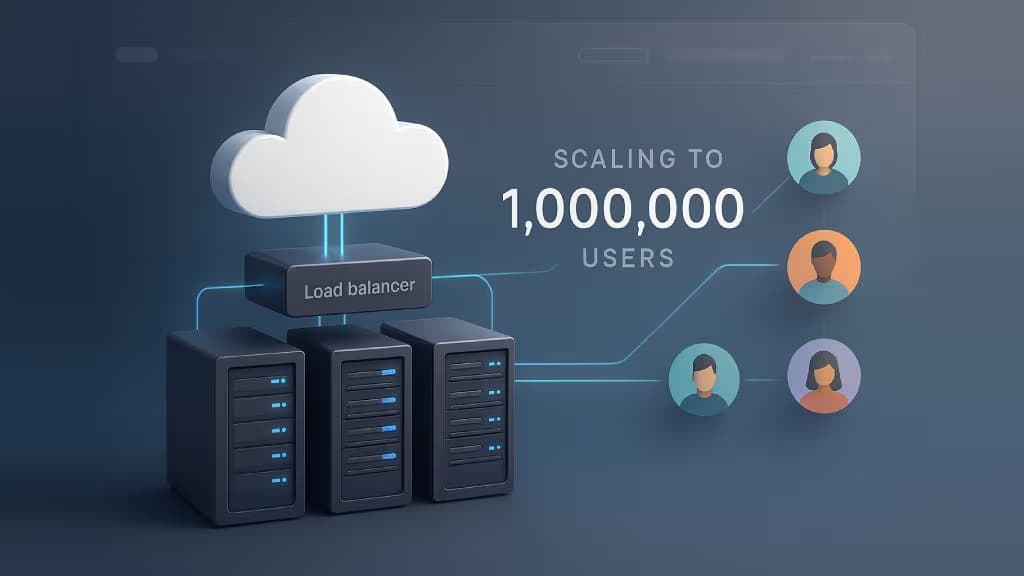
Every developer dreams of building something that suddenly explodes with users. One day you have a handful of people using your app, and the next day thousands — maybe even millions — are hitting your backend.
The problem? Most applications are not built to survive that moment.
Scaling a backend isn’t just about buying a bigger server. It’s about designing systems that can grow without collapsing under their own weight. In this article, we’ll walk through the backend architecture principles that help applications scale from 0 to 1 million users.
Start Simple — But Start Smart
Many developers overengineer systems before they even have users. The truth is that you don’t need Kubernetes, distributed microservices, and message queues on day one.
What you do need is a clean and modular architecture.
A typical starting backend stack might look like this:
- Node.js / Java / Python backend
- Single relational database (PostgreSQL or MySQL)
- Cloud hosting (AWS, GCP, or Azure)
At the beginning, the priority is shipping fast and validating your product, not building the next Netflix infrastructure.
But even in the early stages, structure your code so it can grow.
Good practices early on include:
- Separating services and controllers
- Avoiding tightly coupled components
- Using environment-based configurations
- Writing scalable database schemas
These small habits make scaling much easier later.
The First Bottleneck: Your Database
When applications start growing, the database becomes the first major bottleneck.
Every request might read or write data, and as users increase, queries begin to slow down.
Common solutions include:
Database Indexing
Indexes drastically improve read performance.
For example:
- Filtering bookings by date
- Sorting products by price
Without indexes, the database scans entire tables, which becomes extremely slow at scale.
Query Optimization
Avoid inefficient queries like:
- SELECT * when you only need two columns
- Repeated queries inside loops
Small optimizations here can reduce load dramatically.
Caching: The Secret Weapon of Scale
One of the most powerful ways to scale a backend is caching.
Instead of repeatedly fetching the same data from the database, you store frequently used data in memory.
Popular caching tools include:
For example, imagine an eCommerce homepage showing:
Instead of querying the database for every user, you cache the result and serve it instantly.
Benefits of caching include:
Caching is often the difference between 1000 users and 100,000 users.
Horizontal Scaling: Adding More Servers
At some point, a single server will not be enough.
This is where horizontal scaling comes in.
Instead of upgrading to a larger machine, you add more servers and distribute traffic across them.
This is done using a load balancer, which routes incoming requests to multiple backend instances.
Typical setup:
Users
↓
Load Balancer
↓
Backend Server 1
Backend Server 2
Backend Server 3
If one server fails, the others continue serving requests. This improves both performance and reliability.
Asynchronous Processing with Queues
Not every task should happen instantly during an API request.
Some operations are expensive, such as:
If these tasks run inside the request lifecycle, your API becomes slow.
Instead, you can use message queues like:
The request simply places a job in the queue, and background workers process it later.
This keeps APIs fast even during heavy traffic.
Rate Limiting and Security
When your application becomes popular, you’ll start seeing:
Rate limiting protects your backend by restricting how many requests a user or IP can make.
For example:
- 100 requests per minute per user
- 1000 requests per hour per API key
Tools like API gateways and middleware can enforce these rules.
Without rate limiting, even a small attack can take down your entire system.
Monitoring and Observability
Scaling systems without monitoring is like flying blind.
You need visibility into:
Popular monitoring tools include:
Logs and metrics help detect issues before users notice them.
For example, if response times suddenly spike, you can identify the slow endpoint quickly.
The Real Secret to Scaling
The biggest misconception about scaling is that it’s only about technology.
In reality, scaling is about simplicity, clarity, and smart decisions over time.
The best backend architectures evolve gradually:
- Start with a clean monolith
- Optimize the database
- Introduce caching
- Scale horizontally
- Add queues for heavy tasks
- Split services when necessary
Each step solves a real problem instead of introducing unnecessary complexity.
Final Thoughts
Building software that can scale to millions of users isn’t about copying the architecture of big tech companies.
It’s about building systems that evolve as your product grows.
The most successful systems start small, stay simple, and scale step by step.
So if you’re building the next big product, remember:
Don’t design for a million users on day one.
Design so your system can reach a million users when the time comes.