Every team starts with manual deployments.
A developer finishes a feature, someone logs into a server, runs a few commands, updates configurations, and pushes the latest version live. It works. Until it doesn’t.
As applications grow, release frequency increases, and more people contribute to the codebase, manual deployments become one of the biggest sources of delays, errors, and operational risk.
That’s why modern engineering teams automate deployments through CI/CD pipelines.
Not because it’s trendy. Because it makes business sense.
The Hidden Cost of Manual Releases
Most deployment problems don’t come from bad code.
They come from the process around it.
A missed environment variable.
A forgotten configuration update.
A deployment step that worked in staging but was skipped in production.
Individually, these mistakes seem small.
Collectively, they lead to failed releases, emergency rollbacks, delayed launches, and engineering time spent fixing preventable issues instead of building new features.
The more often you deploy, the more expensive manual processes become.
“Every manual deployment step is another opportunity for human error.”
What CI/CD Actually Does
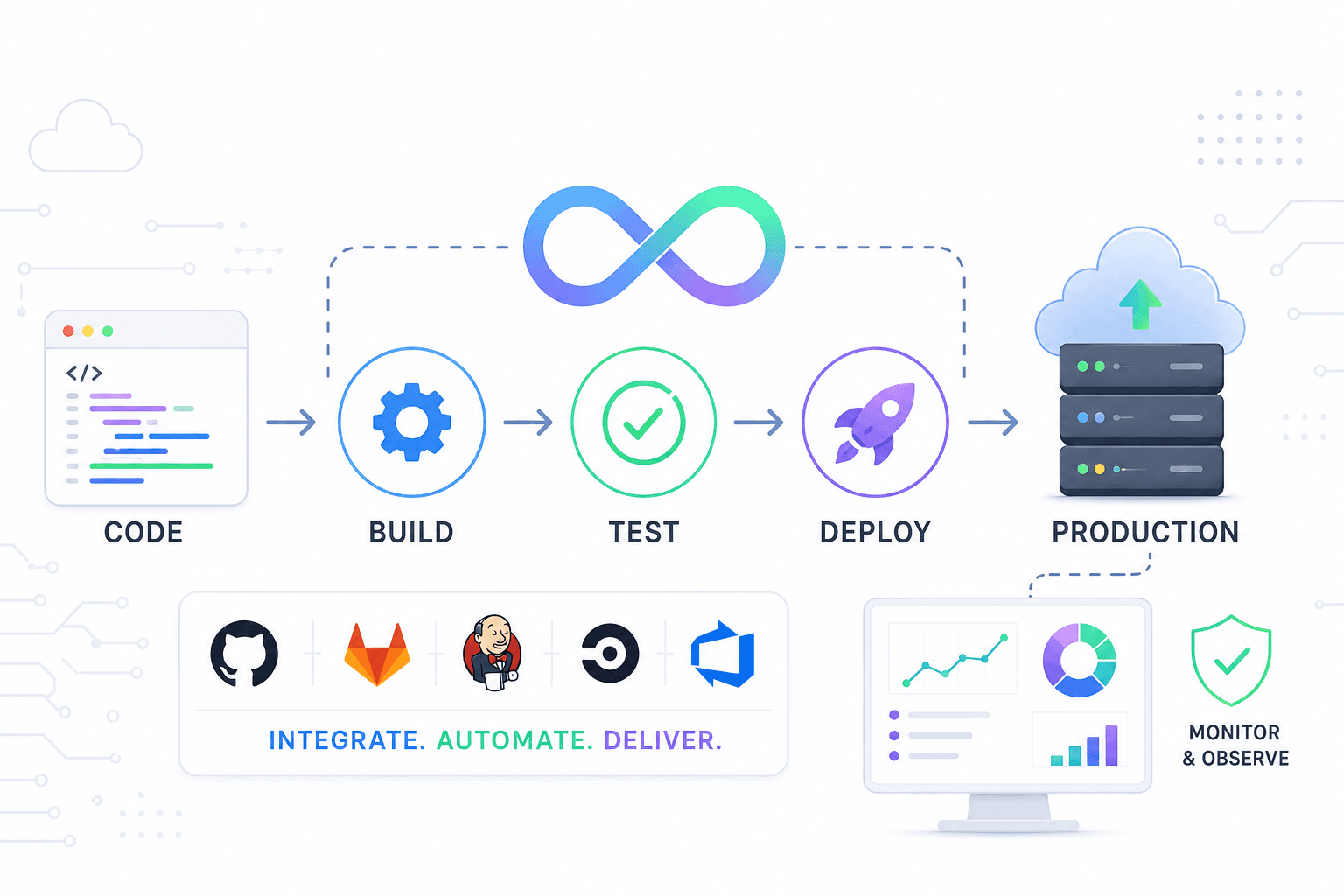
Think of a CI/CD pipeline as an automated assembly line for software.
Instead of relying on people to manually build, test, and deploy applications, the entire process follows a predefined workflow.
When code is pushed:
- The application is built automatically
- Tests are executed automatically
- Quality checks are performed automatically
- Deployments are triggered automatically
The result is a release process that’s faster, repeatable, and far less dependent on human intervention.
Why This Is a Business Decision, Not Just a Technical One
Faster Time to Market
Features, improvements, and fixes reach customers sooner. Businesses can respond more quickly to market demands without waiting for lengthy release cycles.
Fewer Production Issues
Automated validation catches many problems before they ever reach customers.
Reduced Operational Costs
Engineers spend less time managing deployments and more time delivering value.
Better Reliability
Every deployment follows the same process, reducing inconsistencies between environments.
Easier Scaling
As teams grow, deployment complexity grows with them. Automation allows organizations to scale without multiplying operational overhead.
How We Use Jenkins to Streamline Releases
At ViteTech, Jenkins plays a key role in our deployment workflow.
Instead of manually coordinating releases, Jenkins automates critical stages of the software delivery process, including:
- Environment-specific releases
- Release monitoring and notifications
This creates a consistent deployment experience across projects while reducing the risk of deployment-related incidents.
The goal isn’t simply to release software faster.
It’s to release software confidently.
When Deployment Automation Delivers the Biggest Value
✓ Strong business case
- Applications with frequent updates
- Customer-facing platforms
- Cloud-native applications
- Products requiring high reliability
— Less impactful
- Small internal tools with infrequent releases
- Short-term proof-of-concept projects
- Applications with minimal deployment frequency
The Mindset Shift That Matters
Many organizations view deployment automation as an engineering improvement.
The most successful teams see it differently.
They view it as a business enabler.
When releases become predictable, teams can ship features faster. When deployments become reliable, customers experience fewer disruptions. When engineers spend less time on repetitive tasks, they spend more time innovating.
Automation isn’t just about reducing effort.
It’s about creating a delivery process that can support growth without becoming a bottleneck.