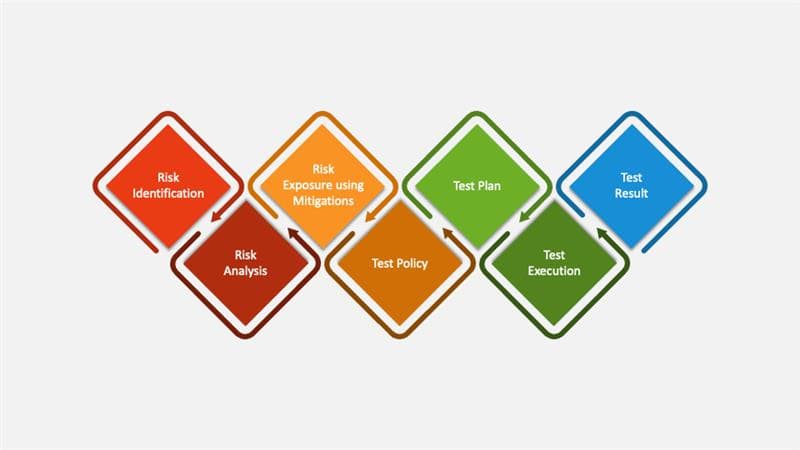
In today’s fast-paced software delivery landscape, testing everything is an expensive illusion that stalls deployments. Risk-Based Testing shifts the focus from exhaustive coverage to strategic mitigation, ensuring your team tests what actually matters. By aligning your testing efforts with business impact and failure probability, you can confidently accelerate release cycles without compromising on production quality.
The Fallacy of 100% Test Coverage
For years, engineering teams have chased the holy grail of 100% test coverage, believing that more tests automatically equate to better software. This is a costly misconception. In reality, pursuing absolute coverage leads to bloated test suites, sluggish CI/CD pipelines, and high maintenance overhead. When every minor code change triggers a multi-hour test suite, developer velocity plummets, and time-to-market stretches. Furthermore, not all code paths are created equal. A bug in a critical checkout funnel can devastate business revenue, while a layout glitch on an archived help page has negligible impact. Treating these scenarios with equal testing weight is an inefficient allocation of engineering resources.
By shifting away from the dogmatic pursuit of full coverage, teams can redirect their energy toward high-leverage testing. Risk-Based Testing acknowledges that resources are finite and that software quality is best preserved by focusing on areas where failure is both likely and highly disruptive. This approach allows teams to build leaner, faster, and more meaningful test suites that directly protect the business’s bottom line.
Decoding Risk: Impact vs. Probability
To implement Risk-Based Testing effectively, teams must learn to systematically quantify risk. Risk is fundamentally defined by two variables: Probability of Failure (how likely is this component to break?) and Business Impact (what happens to the user or the business if it does break?). Assessing probability requires looking at technical factors such as code complexity, churn rate, historical defect density, and the maturity of the technology stack. For instance, a newly refactored legacy module has a high probability of failure.
On the other side of the equation, business impact is determined by financial, operational, and reputational consequences. A failure in the payment gateway has a massive impact, whereas a failure in the user profile picture upload feature is inconvenient but manageable. By analyzing these two dimensions, teams can categorize features into a clear risk hierarchy, allowing QA engineers to prioritize test design and execution where it matters most. This systematic categorization ensures that engineering efforts are always aligned with actual business risk.
Building a Practical Risk Assessment Matrix
The most effective way to operationalize this concept is by establishing a collaborative Risk Assessment Matrix. This matrix brings together product managers, developers, and QA engineers to map out features on a grid, typically ranging from low to high risk. Product managers provide valuable insights into user behavior and business value, while developers highlight technical complexity and architectural fragility. Once features are mapped, you can align your testing strategies accordingly:
- High Risk (High Impact, High Probability): These require comprehensive automated unit, integration, and end-to-end tests, complemented by rigorous exploratory testing.
- Medium Risk: These are covered by core integration tests and automated regression suites run on a daily basis.
- Low Risk (Low Impact, Low Probability): These can rely on basic unit tests or be verified manually only during major releases.
This structured approach removes subjectivity from testing, ensuring that your team’s effort is directly proportional to the risk profile of the application. It transforms testing from a guessing game into a repeatable, data-driven science.
Integrating Risk-Based Testing into Your CI/CD Pipelines
A risk strategy is only as good as its execution, and in modern software development, this execution must live within your CI/CD pipeline. To prevent testing from becoming a deployment bottleneck, you should tag your test suites based on the risk levels defined in your matrix. For example, using modern testing frameworks, you can tag critical-path tests with @smoke or @tier-1, and less critical tests with @regression or @tier-2.
When a developer pushes code, the pipeline should instantly run the Tier 1 suite, providing feedback within minutes. The comprehensive Tier 2 and Tier 3 suites can be scheduled to run nightly or triggered only when changes touch specific high-risk directories. This tiered execution model ensures that developers maintain high velocity during active coding sessions, while the system still maintains a robust safety net that executes deeper validation asynchronously or at strategic release gates. By decoupling immediate feedback from exhaustive validation, you achieve both speed and safety.
Overcoming Cultural Resistance to Selective Testing
Transitioning to Risk-Based Testing often meets with resistance from stakeholders who equate ‘untested’ with ‘broken.’ Overcoming this cultural hurdle requires a shift in mindset from absolute risk elimination to calculated risk management. Engineering leaders must foster a culture where QA is viewed as a strategic advisory partner rather than a safety net that catches every minor bug. To build trust, teams should track key metrics that demonstrate the efficacy of Risk-Based Testing.
“Quality is not about running the most tests; it is about running the right tests at the right time to minimize exposure.”
Monitor your Defect Leakage Rate (the percentage of bugs that escape to production) alongside your overall Cycle Time (the speed of your deployments). When stakeholders see that cycle times decrease dramatically while production defect rates remain stable, the anxiety surrounding selective testing quickly dissipates. Ultimately, Risk-Based Testing is not about cutting corners; it is about making informed, data-driven decisions that balance speed and quality.
Key Takeaways for Engineering Leaders
Embracing Risk-Based Testing is a crucial step for any engineering organization looking to scale their development practices without sacrificing software stability. By treating testing as a dynamic, risk-mitigation tool rather than a rigid compliance checklist, your team can deliver value to users faster and with greater confidence. Start small by mapping your core user journeys, aligning your cross-functional teams on what constitutes a high-risk failure, and restructuring your deployment pipelines to support tiered feedback loops.
As your engineering maturity grows, refine your risk matrix based on real-world production metrics and post-mortem feedback. Remember, the goal of modern software delivery is not to write the most tests, but to deliver the most value with the highest possible reliability. At ViteTech, we have seen firsthand how shifting to a risk-aware mindset transforms engineering velocity, turning QA from a release bottleneck into a powerful competitive accelerator.