As enterprises rush to integrate Generative AI into their core operations, decision-makers face a critical architectural fork in the road: Retrieval-Augmented Generation (RAG) or Fine-Tuning. While both pathways promise to customize Large Language Models (LLMs) with proprietary business data, they serve fundamentally different technical needs, carry distinct cost profiles, and solve separate classes of problems. This guide breaks down the mechanics, trade-offs, and decision matrices to help your engineering team choose the optimal path for your enterprise workloads.
The Mechanics of Retrieval-Augmented Generation (RAG)
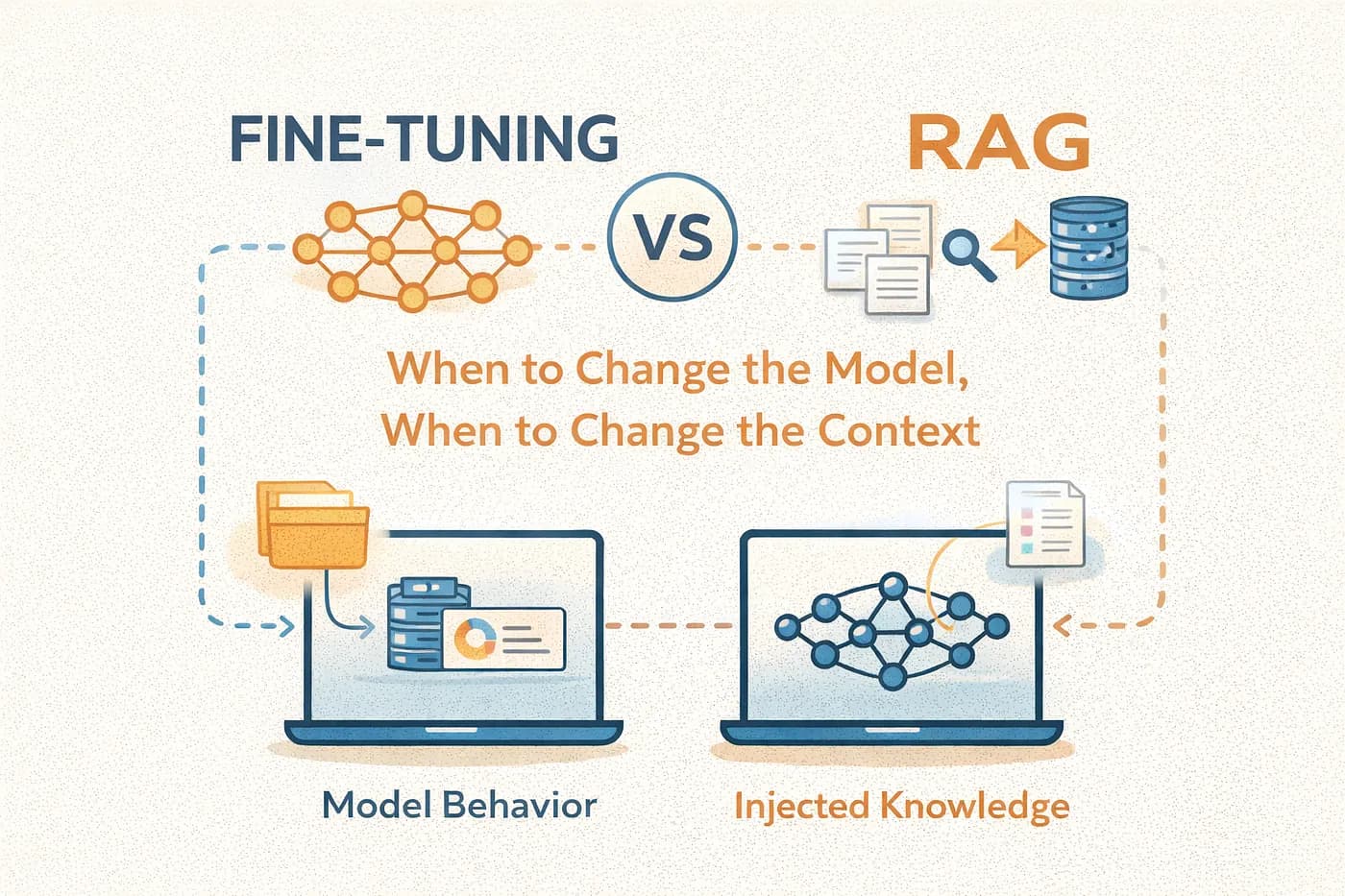
Retrieval-Augmented Generation (RAG) is an architectural pattern that optimizes LLM outputs by querying an external, authoritative knowledge base before generating a response. Instead of relying solely on the static knowledge frozen within the LLM’s weights during training, RAG dynamically retrieves relevant context from enterprise documents, databases, or APIs. This process begins by converting unstructured data into vector embeddings and storing them in a dedicated vector database like pgvector, Pinecone, or Milvus. When a user submits a query, the system performs a semantic search to locate the most relevant information chunks. These chunks are then injected directly into the LLM’s prompt context window, acting as an “open-book” reference.
This architecture offers massive advantages for enterprise applications. First, it solves the problem of data freshness; updating your system’s knowledge is as simple as updating the documents in your vector database, with no retraining required. Second, it drastically reduces hallucinations by forcing the model to ground its answers in the provided source material. Finally, it allows for robust access control, ensuring that the retrieval pipeline only fetches documents the user is authorized to see.
- Dynamic Context: Pulls real-time information from internal databases.
- Source Attribution: Allows the model to cite exact documents and sources.
- Access Control: Integrates with existing enterprise security permissions easily.
Deep Dive into Fine-Tuning and Parameter Optimization
Fine-tuning involves taking an existing pre-trained foundation model and training it further on a curated, domain-specific dataset. Unlike RAG, which provides external context at inference time, fine-tuning actually alters the model’s internal weights. This process can range from full parameter fine-tuning—which is computationally expensive and requires significant GPU resources—to Parameter-Efficient Fine-Tuning (PEFT) techniques like Low-Rank Adaptation (LoRA) and QLoRA. These modern methods freeze the majority of the base model’s parameters and inject small, trainable adapter layers, dramatically reducing the compute power and memory required.
Fine-tuning is highly effective when you need to teach an LLM a specific tone, style, formatting structure, or highly specialized vocabulary that isn’t present in standard training data. For instance, if your enterprise requires an assistant that outputs structured JSON matching a strict schema, or needs to write code in a proprietary internal programming language, fine-tuning is the ideal approach. It is essentially a “closed-book” exam where the model has deeply internalized the patterns, syntax, and behaviors required for highly specialized tasks.
Fine-tuning does not teach a model new facts as reliably as it teaches new styles, formats, and domain-specific behaviors.
Factuality, Real-Time Data, and Hallucination Mitigation
When deciding between RAG and fine-tuning, the nature of your data and your tolerance for factual errors are critical decision vectors. Enterprise data is rarely static; product catalogs, HR policies, and financial ledgers change daily. For dynamic data environments, RAG is the undisputed winner. Because RAG decouples knowledge storage from the LLM itself, updating system knowledge is instantaneous. In contrast, updating a fine-tuned model’s knowledge base requires running a new training pipeline, which is slow, expensive, and impractical for rapidly changing information.
Furthermore, RAG provides unparalleled hallucination control and auditability. Because the system retrieves specific document chunks, you can present citations and source links directly to the end-user. This creates a transparent audit trail. A fine-tuned model, on the other hand, acts as a “black box.” It generates answers based on statistical probabilities encoded in its weights, making it prone to confident hallucinations when asked about facts it wasn’t explicitly trained on or has partially forgotten due to catastrophic forgetting.
Evaluating Total Cost of Ownership and Engineering Complexity
The decision-making process must also account for the Total Cost of Ownership (TCO) and the engineering complexity associated with each architecture. Implementing a RAG pipeline requires building and maintaining a data ingestion pipeline, managing a vector database, optimizing document chunking strategies, and tuning retrieval algorithms (such as hybrid search or re-ranking). While this requires solid software engineering and DevOps practices, it relies on standard database concepts and API integrations, making it highly accessible to traditional software development teams.
Fine-tuning, conversely, demands deep machine learning expertise and significant upfront computational investment. Provisioning high-end GPUs (such as NVIDIA A100s or H100s) for training can be incredibly costly. Moreover, the success of fine-tuning hinges entirely on the quality of your training data. Curating, cleaning, and labeling thousands of high-quality prompt-response pairs is a labor-intensive process. If your dataset contains biases or formatting errors, the fine-tuned model will internalize and amplify those flaws, leading to poor performance that is difficult to debug.
The Hybrid Paradigm: When to Use Both
Fortunately, enterprise architects do not always have to choose one over the other. The most sophisticated AI systems utilize a hybrid paradigm that combines the strengths of both RAG and fine-tuning. In a hybrid architecture, you use fine-tuning to optimize the model’s behavior, tone, style, and formatting capabilities, while using RAG to supply the factual, real-time knowledge context.
For example, consider a medical diagnostic assistant. You might fine-tune a base model on medical transcription formatting, clinical terminology, and patient communication guidelines so that it speaks like a professional physician and outputs structured clinical summaries. Simultaneously, you implement a RAG pipeline that connects this fine-tuned model to the latest medical journals, pharmaceutical databases, and patient electronic health records (EHR). By combining these approaches, the model gains the specialized behavioral characteristics of a fine-tuned agent along with the factual accuracy, real-time updates, and source attribution provided by a robust RAG infrastructure.
Wrapping Up: Navigating Your Enterprise AI Roadmap
Choosing between RAG and fine-tuning is not a matter of finding the “better” technology, but rather matching the architecture to your specific business requirements, budget, and data dynamics. Here is how to navigate your enterprise AI roadmap:
- Start with RAG: For the vast majority of enterprise use cases, Retrieval-Augmented Generation should be your starting point. It is ideal when factual accuracy, real-time data access, and rapid deployment are paramount, offering a faster time-to-market, lower initial costs, and easier maintenance.
- Pivot to Fine-Tuning: When your application demands strict adherence to complex output structures, specialized domain language, or ultra-low latency, investing in fine-tuning becomes a strategic necessity.
- The ViteTech Recommendation: Start with a robust RAG prototype to validate your business case, and then selectively introduce fine-tuning as your performance and behavioral requirements mature.
Balancing these two paradigms will allow your organization to build scalable, secure, and highly intelligent AI agents.