As AI tools accelerate design execution, the gap between Product Design and Strategy has widened. Learn how these two distinct roles complement each other to drive user satisfaction and business growth.
What’s the Real Difference in 2026?
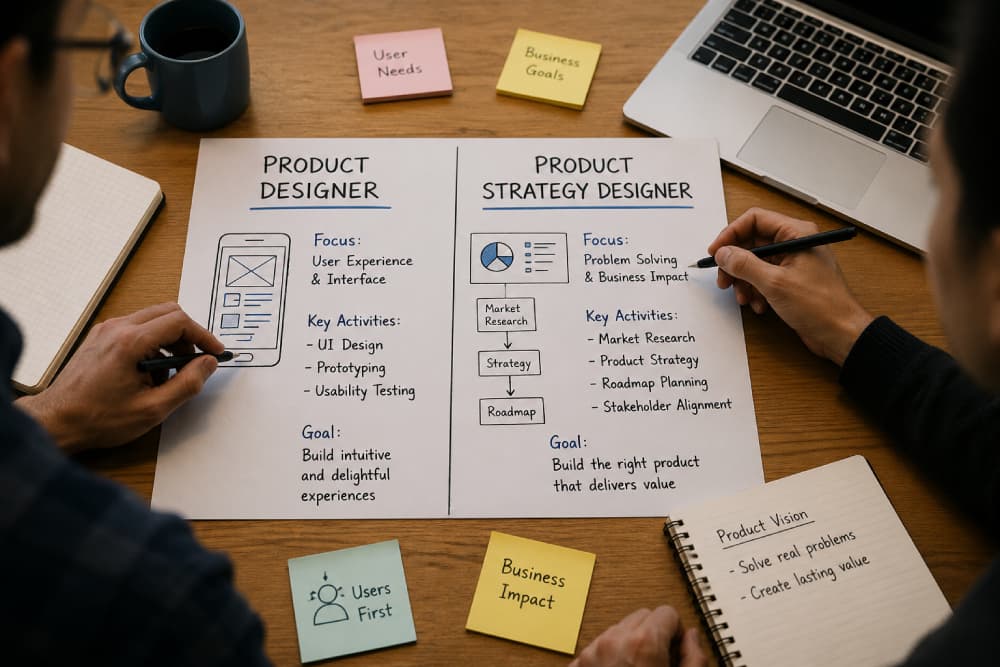
In 2026, the landscape of digital product creation has shifted. With modern tools accelerating prototyping and UI generation, the design industry has bifurcated into two highly specialized paths. While often confused, the roles of a Product Designer and a Product Strategy Designer focus on fundamentally different phases of the product lifecycle. Here is a breakdown of their core differences and how they impact your development team.
The Product Designer (The “Execution & Experience” Specialist)
This role is the natural evolution of traditional UX/UI design. They are the builders who ensure the product is intuitive, accessible, and delightful to use.
The Concept:
-
Focuses on how a feature should be built and experienced.
-
Heavily involved in interaction design, design system governance, and prototyping.
-
Works closely with frontend engineers to ensure the final implementation matches the intended user experience flawlessly.
The Advantages:
-
Creates a polished, frictionless user experience that drives retention and user engagement.
-
Rapidly turns abstract requirements into tangible, interactive UI components.
-
Ensures accessibility standards and fluid, responsive design across all devices.
The Drawbacks:
The Product Strategy Designer (The “Vision & Value” Specialist)
This role sits at the intersection of design, business, and product management. They are responsible for determining if a feature is actually worth building.
The Concept:
-
Focuses on what should be built next and why, backed by market data and user research.
-
Maps complex service blueprints, user journeys, and overarching product architectures.
-
Aligns design initiatives directly with business objectives, OKRs, and market viability.
The Advantages:
-
Prevents engineering and design teams from wasting time building features the market doesn’t need.
-
Bridges the communication gap between C-suite stakeholders and the execution teams.
-
Excels at identifying new market opportunities and creating long-term, sustainable product roadmaps.
The Drawbacks:
-
Deliverables are often abstract (documents, maps, charts) rather than clickable UI, which can be harder for visual stakeholders to grasp.
-
Requires a deep understanding of business economics and market fit, which is outside standard design training.
Impact on Product Lifecycle and Scaling
How these roles integrate heavily determines the trajectory of your product’s growth.
Product Design Impact:
-
Speeds up the development cycle by providing clear, component-based design handoffs to the engineering team.
-
Focuses on optimizing user flows, reducing friction, and improving task completion rates.
Strategy Design Impact:
-
Defines the “North Star” of the product, ensuring that as the application scales, it doesn’t become a bloated mess of unrelated features.
-
Prioritizes the product backlog based on maximum user impact and business value.
Final Thoughts
In modern development environments, these roles are not interchangeable; they are symbiotic. If your team is struggling with a disjointed UI or poor usability, you need a strong Product Designer to fix the execution. If your product looks incredible but isn’t solving the right market problem or driving revenue, a Product Strategy Designer is the crucial missing piece to realign your vision.