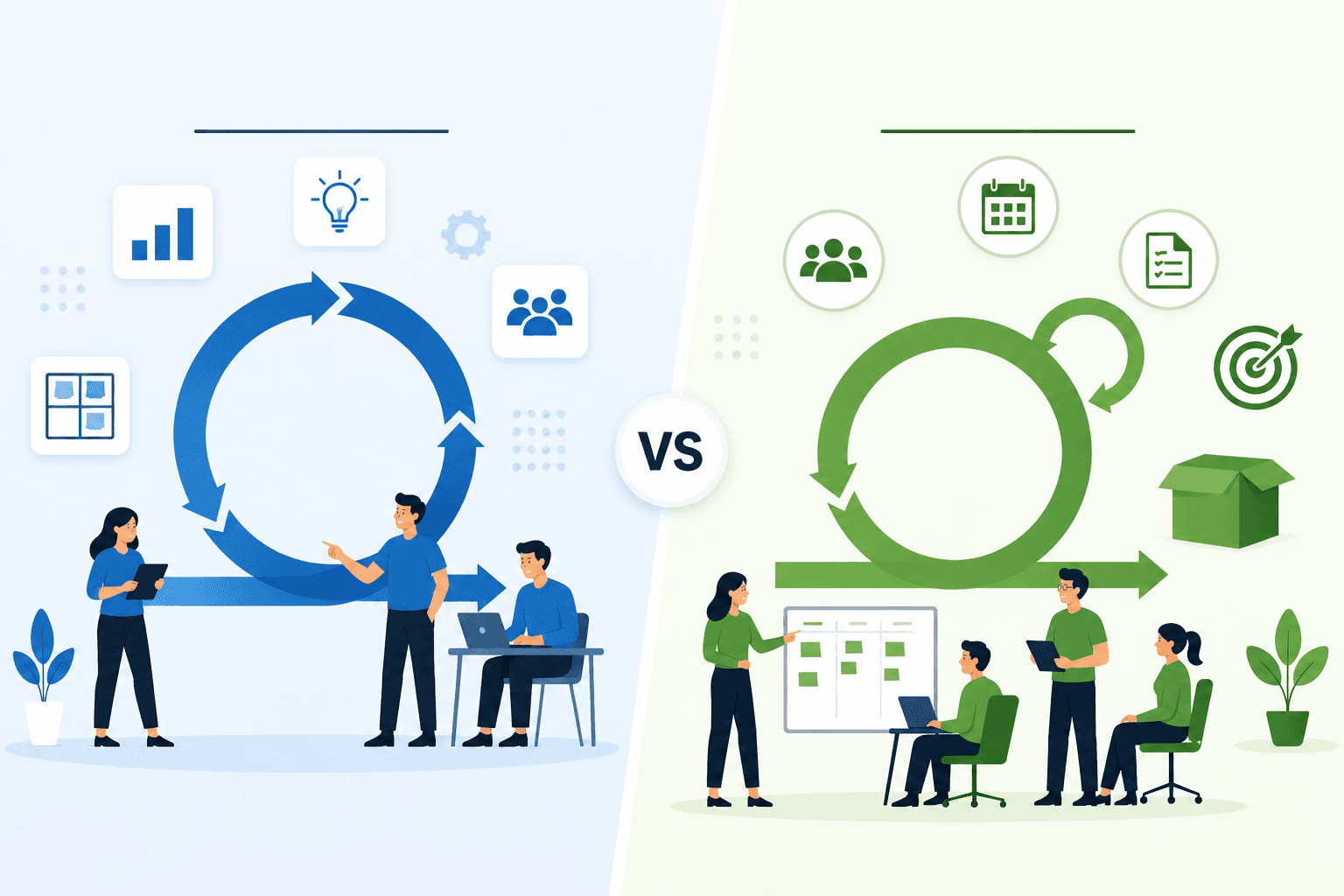
In today’s fast-paced digital world, organizations are constantly looking for ways to deliver projects faster, improve collaboration, and adapt quickly to changing customer needs. This is where Agile and Scrum come into the picture.
Although these terms are often used interchangeably, Agile and Scrum are not the same. Understanding their differences can help teams choose the right approach for successful project delivery.
What is Agile?
Agile is a project management philosophy and mindset based on flexibility, collaboration, continuous improvement, and customer-centric delivery.
Instead of following a rigid plan from start to finish, Agile encourages teams to:
- Deliver work in smaller increments
- Gather continuous feedback
- Adapt to changing requirements
- Improve through collaboration
The Agile methodology is guided by the Agile Manifesto, which values:
- Individuals and interactions
- Working software
- Customer collaboration
- Responding to change
Benefits of Agile
✅ Faster delivery of value
✅ Improved customer satisfaction
✅ Better adaptability to change
✅ Increased team collaboration
✅ Continuous improvement
What is Scrum?
Scrum is a framework used to implement Agile principles in a structured way.
It provides teams with a defined process, roles, events, and artifacts to manage work efficiently.
Scrum focuses on delivering work in short cycles called Sprints, usually lasting 2–4 weeks.
Key Scrum Roles
1. Product Owner
Responsible for:
- Managing the Product Backlog
- Prioritizing requirements
- Maximizing product value
2. Scrum Master
Responsible for:
- Facilitating Scrum practices
- Removing blockers
- Supporting the team
3. Development Team
Responsible for:
- Delivering working increments
- Collaborating during Sprint execution
Scrum Events
Sprint Planning
The team plans the work to be completed during the Sprint.
Daily Scrum
A short daily meeting to discuss:
- What was completed?
- What will be done next?
- Any blockers?
Sprint Review
The team demonstrates completed work to stakeholders.
Sprint Retrospective
The team reflects on:
- What went well
- What can be improved
- Action items for the next Sprint
Agile vs Scrum – Key Differences
| Agile |
Scrum |
| A mindset and philosophy |
A framework |
| Focuses on flexibility |
Focuses on structured execution |
| Broad approach |
Specific implementation method |
| Can use multiple frameworks |
One of the Agile frameworks |
| Emphasizes collaboration |
Emphasizes Sprint-based delivery |
Why Teams Choose Agile and Scrum
Modern organizations prefer Agile and Scrum because they help teams:
- Respond quickly to market changes
- Deliver products faster
- Improve transparency
- Reduce project risks
- Enhance stakeholder engagement
Scrum especially helps teams maintain focus through:
- Clear goals
- Regular feedback
- Continuous delivery cycles
Common Misconception
Many teams believe conducting Daily Standups means they are “doing Agile.”
However, Agile is more than ceremonies and meetings.
True Agile success comes from:
✔ Collaboration
✔ Adaptability
✔ Transparency
✔ Continuous improvement
✔ Customer-focused delivery
Scrum simply provides the structure to practice these principles effectively.
Conclusion
Agile and Scrum have transformed how teams manage projects and deliver value.
Agile provides the mindset for flexibility and continuous improvement, while Scrum offers a practical framework to execute those principles efficiently.
Organizations that combine the right mindset with effective Scrum practices can build high-performing teams, improve delivery speed, and create better customer experiences.