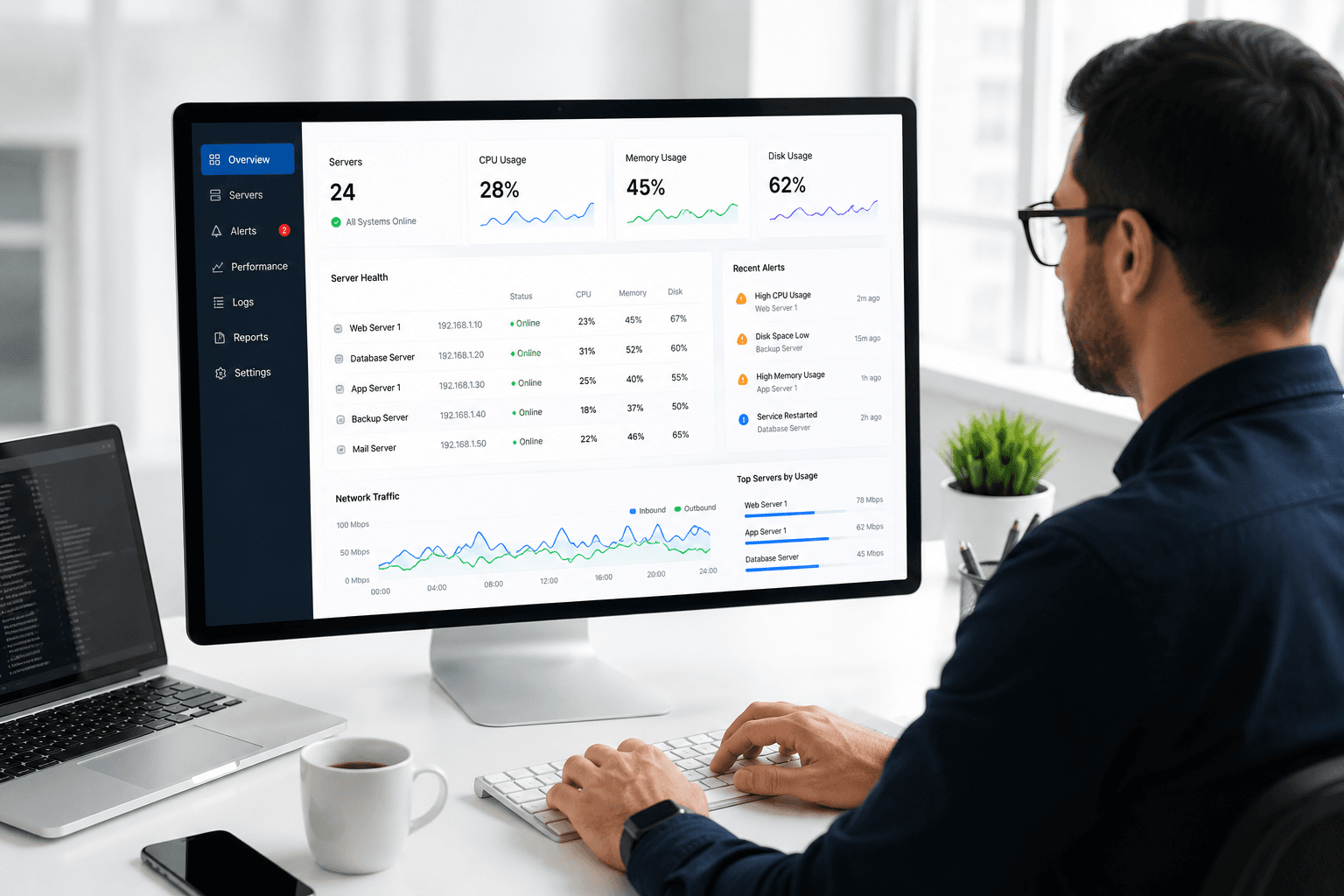
Most outages don’t happen without warning. The signs are usually there: rising CPU usage, memory leaks, slow database queries, increasing response times. The problem is that many teams only discover them after customers start complaining.
Proactive server monitoring changes that. Instead of waiting for systems to fail, it helps teams identify risks early and fix them before they become business problems.
The Cost of Finding Out Too Late
A website going down for a few minutes may seem like a technical inconvenience.
For a business, it’s often much more than that.
Customers can’t complete purchases. Leads can’t submit enquiries. Internal teams lose access to critical systems. Even if the outage lasts only a short time, trust is affected immediately.
What’s surprising is that many outages don’t begin with a crash. They begin with small performance issues that gradually build up over hours or days.
A server running at 95% CPU.
A database that’s slowly getting overwhelmed.
A disk that’s nearly full.
Without visibility, those warnings go unnoticed until something breaks.
“Outages rarely arrive unannounced. Most businesses simply aren’t listening to the warning signs.”
What Proactive Monitoring Actually Means
Think of server monitoring like a health check-up.
You don’t wait until you’re seriously ill to measure your blood pressure or check your heart rate. You monitor key indicators to catch problems early.
Modern monitoring platforms do the same for infrastructure.
They continuously track:
- CPU and memory usage
- Disk capacity
- Network performance
- Database health
- API response times
- Application errors
- Service availability
When unusual patterns appear, alerts are triggered before users experience issues.
Why This Is a Business Decision, Not Just an IT Decision
Protects Revenue
If customers can’t access your application, they can’t buy, book, or engage. Preventing downtime protects revenue that would otherwise be lost.
Improves Customer Trust
Reliable systems create confidence. Users remember seamless experiences far longer than technical specifications.
Reduces Emergency Work
Fixing issues during business hours is far cheaper than waking engineers at 2 AM to respond to an outage.
Supports Growth
As traffic increases, infrastructure becomes more complex. Monitoring provides the visibility needed to scale without surprises.
What We Look For Before Problems Escalate
Rather than monitoring only whether a server is online, modern teams focus on indicators that suggest future issues.
Examples include:
- Gradually increasing memory consumption
- Sudden traffic spikes
- Slow database queries
- Higher-than-normal error rates
- Unusual network latency
- Resource usage approaching limits
The goal isn’t simply detecting failures.
The goal is preventing them.
When Monitoring Delivers the Biggest Value
✓ Strong business case
- Customer-facing applications
- E-commerce platforms
- SaaS products
- APIs serving external partners
- Systems that require high availability
— Less impactful
- Temporary development environments
- Internal tools with minimal usage
- Non-critical workloads where occasional downtime is acceptable
The Mindset Shift That Matters
Many businesses view monitoring as something you add after experiencing an outage.
The most resilient organizations think differently.
They treat monitoring as part of the product itself.
Because customers don’t judge applications by how they’re built. They judge them by whether they’re available when needed.
Preventing downtime isn’t about reacting faster.
It’s about ensuring the problem never reaches the customer in the first place.
ViteTech
We help businesses build reliable, scalable infrastructure that stays ahead of problems instead of reacting to them. From proactive monitoring and alerting to performance optimization and cloud operations, we design systems that keep your applications available when your customers need them most