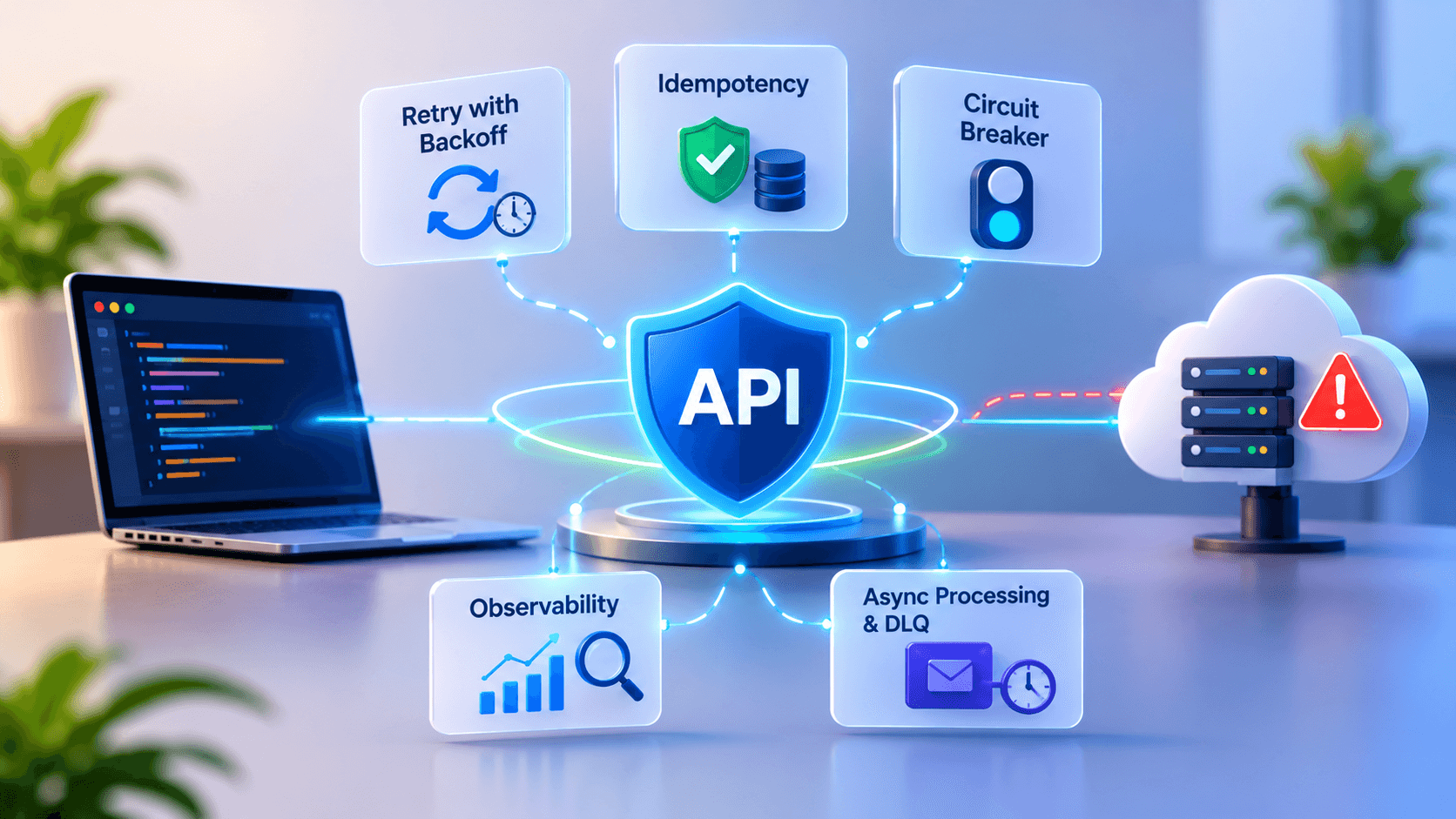
Connecting to a modern third-party API usually takes fewer than ten lines of code in a sandbox environment. However, deploying that same integration to a production ecosystem exposes your software to network blips, undocumented schema drift, rate limiting, and unexpected downtime. At ViteTech, we have seen firsthand how fragile API integrations can silently ruin customer experiences, and this guide outlines the core engineering strategies needed to build truly resilient API architectures.
The Happy Path Illusion vs. Production Reality
When developers build an API integration during initial development, they almost exclusively write code for the happy path. In a local environment or sandbox, latency is negligible, servers never crash, and the response payload perfectly matches the API documentation. A simple fetch() or SDK invocation returns a 200 OK status code, and the feature is marked as complete on the sprint board.
Production systems operate in a far harsher environment. In the real world, distributed networks encounter micro-outages, external services hit strict rate limits during peak traffic hours, and vendors push unannounced patch releases that subtly alter data formats. When these anomalies occur, naive integration code fails catastrophically, often cascading through your downstream microservices.
To build production-grade software, engineering teams must abandon the assumption that external dependencies will always behave. Reliable API engineering requires treating every external network call as a potential point of failure. Here are the primary failure modes every system must anticipate:
- Transient Network Failures: Packet loss, socket timeouts, and temporary DNS resolution issues.
- Upstream Degradation: Latency spikes where an endpoint responds in 30 seconds rather than 200 milliseconds.
- Rate Limiting and Throttling: HTTP
429 Too Many Requests responses triggered by system traffic surges.
- Data Corruption and Schema Drift: Unexpected missing fields, modified data types, or invalid payloads.
Designing for Resilience: Retries, Jitter, and Circuit Breakers
The first line of defense against network instability is a robust retry policy. However, blindly retrying failed HTTP requests using a basic loop can quickly make a bad situation worse. If an upstream service is struggling under heavy load, hundreds of client instances retrying simultaneously will create a thundering herd problem, effectively performing a self-inflicted denial-of-service attack on the provider.
To prevent this, production systems should always implement exponential backoff with jitter. Exponential backoff increases the delay between consecutive retry attempts exponentially (e.g., 1s, 2s, 4s, 8s), while full jitter introduces randomized variance to the delay interval. This random distribution breaks up synchronized retry spikes across client instances, allowing the upstream provider time to recover.
When an external system suffers an extended outage, retrying indefinitely wastes application compute resources and exhausts connection pools. This is where the Circuit Breaker pattern becomes critical. A circuit breaker monitors outbound requests for failure thresholds:
- Closed State: Requests pass through normally while error rates remain below the threshold.
- Open State: When failures breach the threshold, the circuit trips open, immediately failing subsequent requests locally without attempting network calls.
- Half-Open State: After a cooldown period, a limited number of probe requests are allowed through to check if the remote system has recovered.
Implementing circuit breakers protects your internal service architecture from thread starvation and cascading latency when third-party vendors fail.
Mastering Idempotency to Prevent State Corruption
One of the most dangerous aspects of retrying network requests is the risk of duplicate execution. Consider a payment processing API integration: your application sends a POST /v1/charges request, but the network connection drops right before receiving the response. Did the vendor process the payment or fail before execution? If your client automatically retries the request, you risk charging the user twice.
Solving this problem requires strict idempotency mechanisms across all non-idempotent HTTP methods (such as POST and PATCH). An operation is idempotent if executing it multiple times produces the exact same side-effects as executing it a single time.
Engineers can achieve API reliability by attaching unique Idempotency Keys (typically UUID v4 strings) to outbound request headers, such as Idempotency-Key: key_123456789. The receiving server stores the key alongside the initial result. If a duplicate request with the identical key arrives later due to a network retry, the server returns the cached initial response without reprocessing the underlying business logic.
- Generate a unique idempotency key before initiating the network call.
- Persist the key in your local transactional database alongside the pending operation state.
- Pass the key in the external HTTP request header.
- In the event of a timeout or retryable network failure, re-send the request using the same idempotency key.
Defending Against Schema Drift and Silently Breaking Changes
Third-party vendors constantly iterate on their products. Even when providers adhere to semantic versioning, silent breaking changes, deprecated fields, and undocumented data mutations occur. If your application blindly trusts external JSON payloads, a single missing property can trigger unhandled runtime exceptions deep within your application code.
Defensive integration engineering demands that external data be strictly validated at the exact boundary where it enters your network. Rather than casting API responses directly to internal TypeScript types or domain models, use runtime schema validation libraries such as Zod, Valibot, or Pydantic to enforce strict contract boundaries.
When runtime schema validation fails, your system should catch the validation error at the adapter layer, log a detailed structural diff, and execute a controlled fallback mechanism rather than crashing the application thread. Additionally, adopting Consumer-Driven Contract Testing (using frameworks like Pact) within your CI/CD pipelines allows your team to catch breaking API changes before they ever reach your production environment.
Always adhere to Postel’s Law (the Robustness Principle) when designing integration contracts: “Be conservative in what you send, be liberal in what you accept.” Ignore unexpected fields in external payloads rather than throwing errors, ensuring your application remains tolerant of additive upstream schema updates.
Observability Beyond Status 200: Tracing and Alerting
You cannot fix what you cannot measure. Most engineering teams monitor internal server errors (5xx status codes), but completely lack visibility into external service behavior. If an external API starts taking 4 seconds to respond instead of 200 milliseconds, your users will experience a slow application, but your internal health dashboards will remain green.
True API integration reliability requires comprehensive telemetry and distributed tracing. Every outbound HTTP call should be wrapped with instrumentation that records key operational metrics:
- Latency Histograms: Measure p50, p95, and p99 response times for every third-party endpoint.
- HTTP Status Code Distributions: Track the ratio of 2xx, 4xx (client errors/rate limits), and 5xx (upstream server errors) responses over time.
- Correlation IDs: Propagate OpenTelemetry trace headers (such as
traceparent) across outbound requests to trace execution flow through external boundaries.
By establishing clear Service Level Indicators (SLIs) and setting automated alerts on metric anomalies, your platform team can detect vendor outages or latency degradation long before affected customers begin submitting support tickets.
Shift Your Strategy from Integration to Long-Term Resilience
Writing code that connects two software systems is straightforward, but building an integration that seamlessly survives the chaos of production networking requires intentional design. By implementing robust retries with backoff, enforcing strict idempotency, isolating dependencies through circuit breakers, validating schema boundaries defensively, and maintaining deep observability, you protect your application from third-party failures.
At ViteTech, we specialize in helping organizations modernize their platform architectures and build resilient software systems that scale under real-world pressure. If your engineering team is navigating complex API integrations or suffering from third-party reliability issues, reach out to our senior technical consultants to elevate your integration strategy today.